
MalwareMind
End-to-end AI security demo that converts executable binaries into image representations for CNN-based malware family classification.
95%+
EXE Files
CNN
Web App
Problem
Malware classification often depends on specialized tooling, handcrafted features, or signature-based workflows that are difficult to demonstrate in an interactive AI system.
Solution
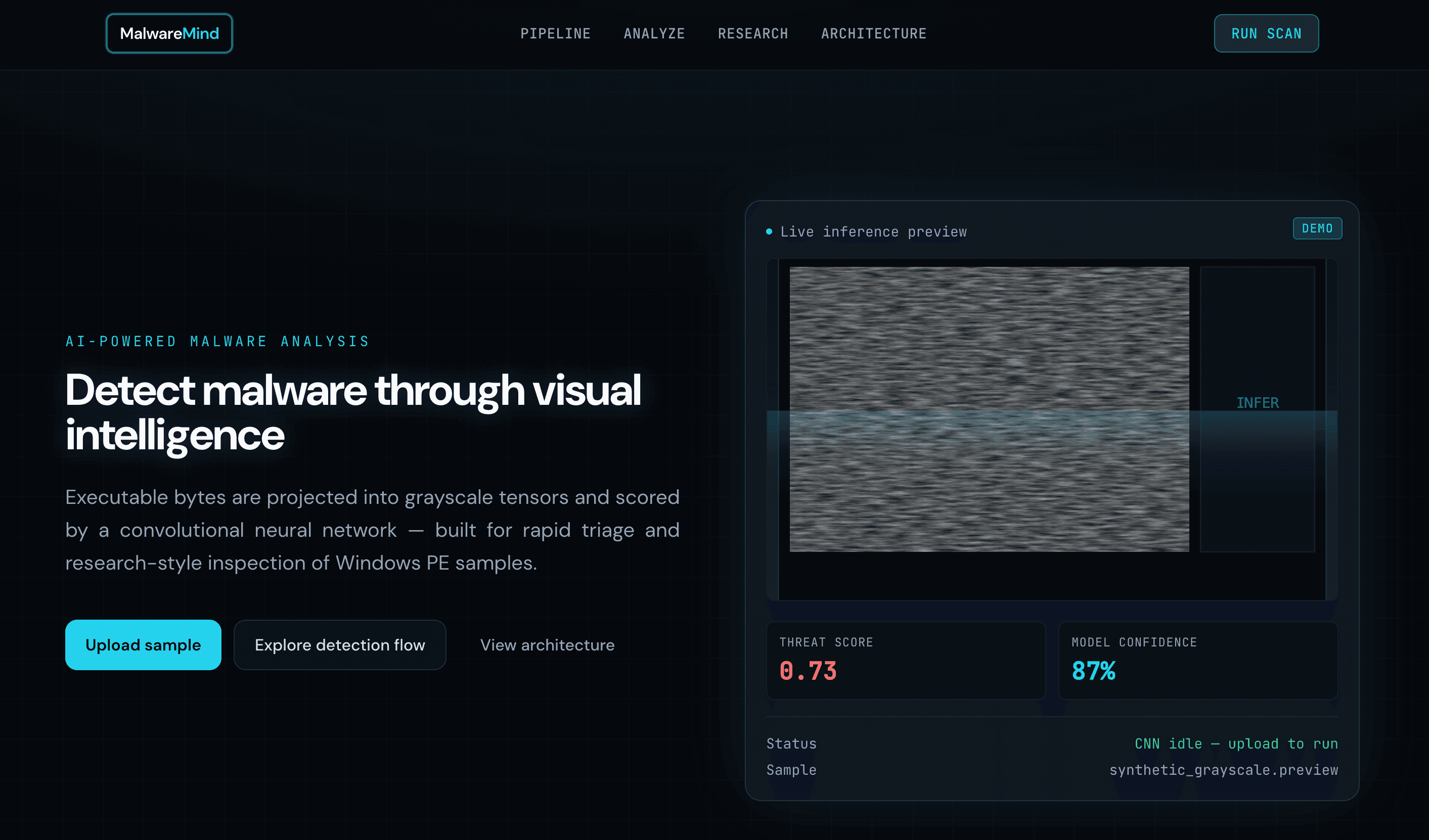
An end-to-end malware classification platform that converts executable binaries into grayscale image representations, runs CNN inference, and presents malware family predictions through a web interface.
Screenshots
Stack
- Python
- TensorFlow
- FastAPI
- Vue.js
- Vercel
Related Concepts
- Malware Detection
- Image-based Classification
- Convolutional Neural Networks
- Applied Machine Learning
- Cybersecurity Analytics
Overview
MalwareMind is a malware detection platform that classifies executable files by transforming them into image-based representations and analyzing them with a convolutional neural network.
Instead of relying only on static signatures or manual inspection, the system treats binary structure as visual patterns that can be learned by a deep learning model.
The project combines applied machine learning, cybersecurity, and web application development into an interactive malware analysis workflow.
Detection Gap
Malware analysis is often difficult to access for users who do not have specialized reverse engineering or security research experience.
Traditional approaches may require manual inspection, signature databases, sandbox environments, or domain-specific tooling.
MalwareMind explores a more approachable workflow:
Can executable files be transformed into visual representations and classified using image recognition techniques?
This creates a bridge between malware analysis and computer vision, making the detection process easier to demonstrate, visualize, and interact with.
System Approach
MalwareMind converts executable files into grayscale image representations, then feeds those images into a trained CNN model for classification.
The platform provides a web interface where users can upload files, run detection, and review classification results.
The system focuses on three core steps:
- File upload and preprocessing
- Binary-to-image transformation
- CNN-based malware classification
Architecture
The system follows an image-based malware classification pipeline:
MalwareMind processing architecture.
Core responsibilities of the platform include:
- Executable file handling
- Binary-to-image conversion
- Malware image preprocessing
- CNN model inference
- Result visualization
- Web-based interaction flow
My Contributions
I owned the end-to-end implementation of MalwareMind, from binary preprocessing and model training through backend inference, frontend workflow, and deployment.
My work included:
- Designing the binary-to-image transformation pipeline for executable files
- Preparing malware image data for CNN training and inference
- Training and evaluating a CNN model for malware family classification
- Building the FastAPI backend for file handling, preprocessing, and model inference
- Developing the web interface for upload, detection, and result display
- Creating visual result summaries for classification outputs
- Deploying the application as an interactive AI security demo
Technical Challenges
Binary-to-Image Transformation
Executable files are not naturally image data.
A key challenge was converting raw binary content into a structured visual format that could preserve meaningful patterns for model training and inference.
The transformation process needed to produce consistent image inputs while still reflecting the internal structure of the executable file.
Model Training and Classification
The CNN model needed to learn visual patterns associated with different malware samples.
This required preprocessing consistency, appropriate input sizing, and careful handling of classification output so that the model could produce meaningful predictions instead of simply memorizing noisy binary artifacts.
Safe Demo Boundaries
Because the system accepts executable uploads, the demo needed clear boundaries around file handling, inference, and result presentation.
The application treats uploaded binaries as analysis inputs rather than executable programs, limiting the workflow to byte-level preprocessing and model inference instead of execution or sandbox behavior.
Web-based Malware Analysis Workflow
Malware detection tools are often command-line based or research-oriented.
MalwareMind was designed as an interactive web platform, which required connecting model inference with a usable frontend experience.
The application needed to support:
- File upload
- Detection progress feedback
- Prediction results
- Visual result summaries
- Clear user interaction flow
Results
The final platform successfully demonstrated:
- Image-based malware classification using CNN models
- Support for executable file upload and analysis
- Classification accuracy above 95%
- Interactive web-based detection workflow
- Visual result presentation for malware analysis
- End-to-end deployment as a usable security demo
The accuracy result reflects evaluation on the prepared malware image dataset for this project and should be read as a prototype benchmark rather than a production malware detection claim.
Key Learnings
This project showed how cybersecurity problems can be reframed as machine learning and representation learning problems.
The most valuable insight was that malware detection is not only about model accuracy, but also about designing the full pipeline around the model: preprocessing, inference, interface design, and result interpretation.
MalwareMind helped me connect applied AI, backend development, and cybersecurity into a complete end-to-end system.
Future Directions
Potential future improvements include:
- Support for additional executable formats
- Larger malware family classification dataset
- Explainable AI visualizations for model decisions
- Static feature extraction combined with image-based detection
- Sandbox-based behavioral analysis integration
- Batch upload and report generation
- Model confidence calibration and risk scoring
More projects
Continue exploring other systems across security, data pipelines, and applied AI.
PQ-SAT
PQC readiness and cryptographic visibility at scale.
- Python
- Polars
- DuckDB
- PostgreSQL
Cybersecurity Compliance Intelligence
Structured regulatory mapping database for cross-referencing cybersecurity standards and compliance frameworks.
- Python
- SQLite
- GraphQL
- Metabase
Web Scraping & Data Extraction Pipelines
Repeatable Python extraction workflows that turn inconsistent semi-structured web sources into structured data for downstream analysis.
- Python
- Requests
- Selenium
- Airflow